

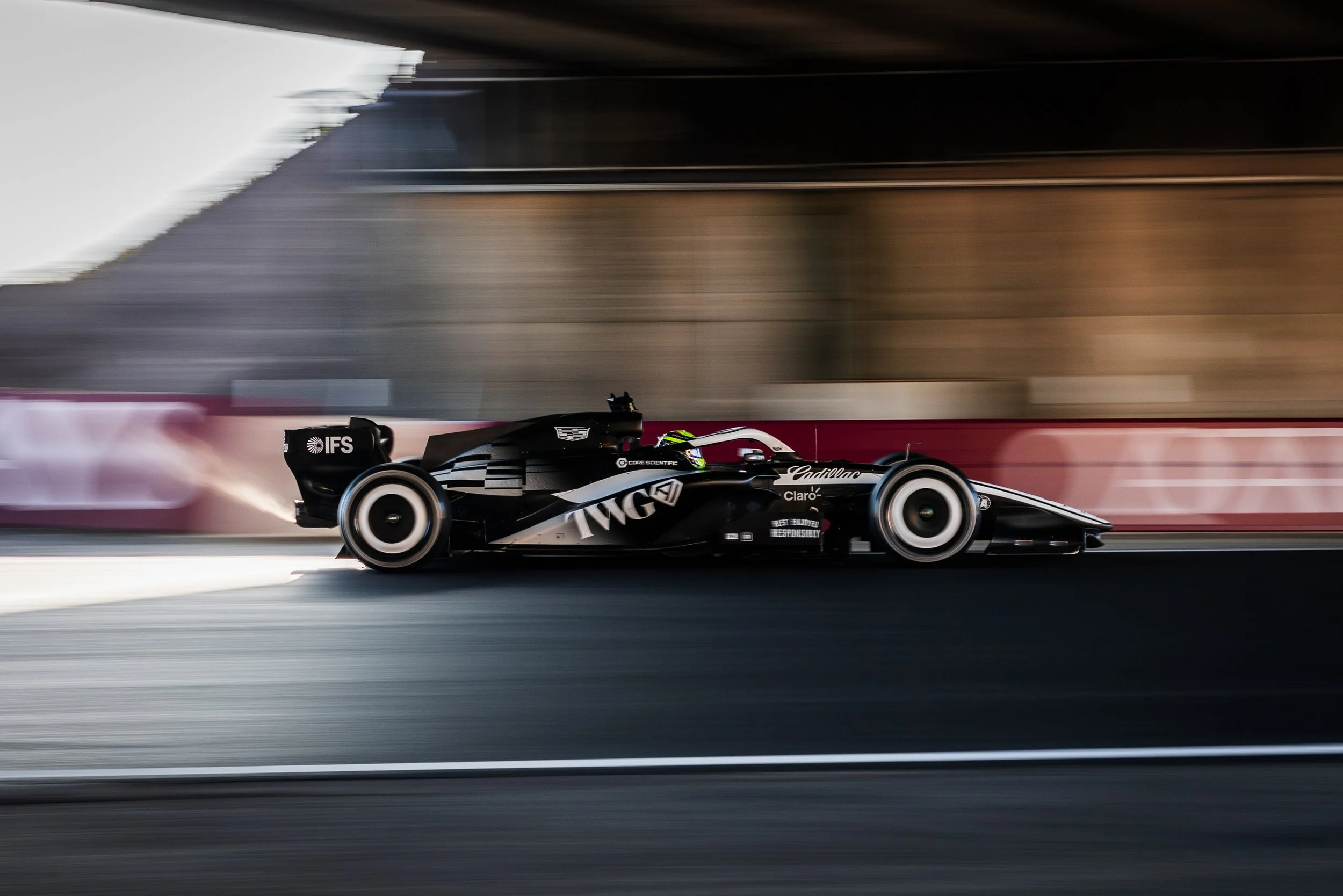
THE GRID JOURNAL
There is always more happening than what you see on track. The Grid Journal is where we get into everything from Partnerships, politics, personalities and the deeper currents shaping the world of Formula 1.
THE FASHION-FORWARD FORMULA
There has been considerable talk about fashion having found its moment in Formula 1. The reality is more nuanced than the narrative suggests.
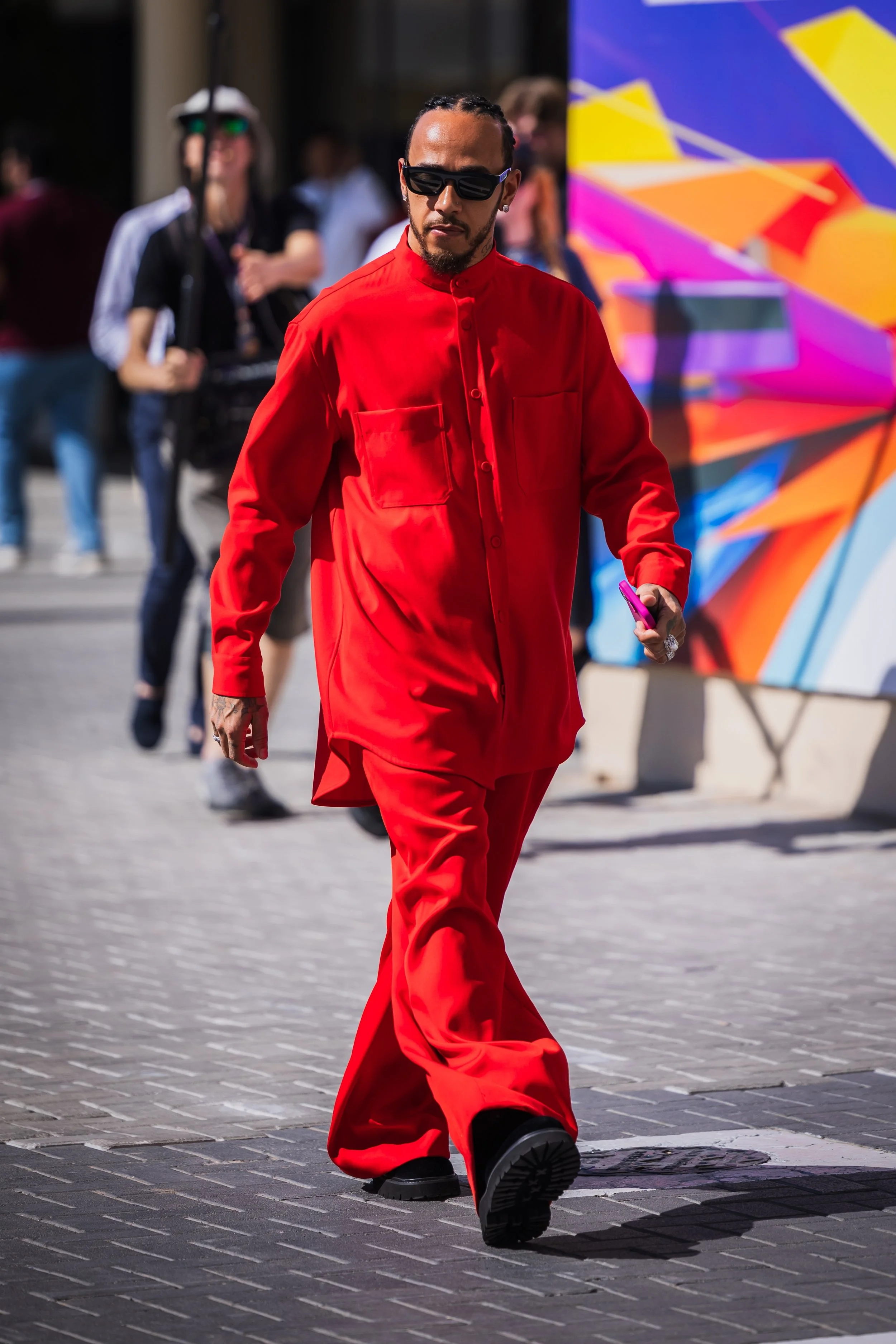
Sir Lewis Hamilton wearing Rick Owens in the Formula 1 Paddock. (Image credit: Jay Hirano - Shutterstock)
There has been considerable talk about fashion having found its moment in Formula 1. The reality is more nuanced than the narrative suggests. What Formula 1 has had is a merchandise moment through apparel, and it is not new; it has simply evolved. Fashion and apparel are not the same thing, and the distinction matters enormously for anyone seeking to build a meaningful position at the intersection of the sport and the fashion industry.
Apparel Is Not Fashion
To assess whether fashion has truly arrived in Formula 1, it is necessary to first separate fashion from apparel. Apparel serves a functional and practical purpose. This includes team kits, fan merchandise, and performance-driven race gear, and while these help build community among fans, they typically do not dictate trends or influence culture beyond the sport itself. Fashion is something different entirely. It is about cultural expression, identity, and storytelling. It is not simply about what is worn, but why, how, and with what significance. That distinction is where the current discourse around Formula 1 and fashion needs much better understanding.
What Formula 1 has achieved over the last several years is a genuine expansion of its addressable apparel market. Fan demographics have shifted, lifestyle appeal has broadened, and premium sportswear partnerships have followed the audience. There is a commercial significance here that should not be dismissed. However, commercial significance is not cultural integration, and the two are being conflated at an expanding rate.
The Partnerships on the Table
Collaborations such as Reiss x McLaren or BOSS x Aston Martin Aramco are real partnerships producing real product. They are also, by any honest structural assessment, brand licensing exercises with elevated positioning. They reflect the sport's growing desirability as a co-branding vehicle. Reiss has released strong collections under its McLaren partnership, and HUGO x Visa Cash App RB has delivered standout pieces. M&S x Williams Racing is the most recent addition to this list, and it will be worth watching closely. These partnerships reflect Formula 1's desirability. They do not yet reflect the fashion industry having renegotiated its relationship with motorsport in any meaningful or lasting way. No creative director has restructured a house around Formula 1. No major fashion week moment has been genuinely shaped by the sport's internal culture rather than its borrowed aesthetics. Formula 1's language has not found expression in fashion, even as fashion's language attempts to find it in Formula 1. That speaks to a sort of one-sidedness, buttressing the point that this is not an organic relationship being developed.
The Logo Problem
The moment a fashion piece requires a team logo to justify its existence within the sport, it has crossed from fashion into branded merchandise with elevated production values. The logo is doing the cultural work that the design should be doing on its own. One can lean into the nuance that co-branding is not automatically disqualifying in fashion. Supreme x Louis Vuitton, for instance, required both logos and still constituted a genuine fashion moment because the creative dialogue between the two entities was real and the resulting pieces had a life beyond the collaboration itself. The test is whether the item would retain its identity and desirability without the partner's name attached.
The key difference when citing the Supreme example is that the brand operates as a creative entity with its own design identity, cultural authority, and independent release cadence. The Louis Vuitton collaboration worked because two fashion-adjacent entities with distinct creative languages met in the middle. Neither needed the other's logo to exist. The meeting of the two iconic logos was the entire point.
That is categorically different from a sports team, whose primary identity is athletic competition. When McLaren collaborates with Reiss, McLaren is not bringing a design language to the table. It is bringing an audience, a colour palette, and a logo. Reiss is doing the fashion work. The team is providing the distribution vehicle. That dynamic is closer to a licensing arrangement than a creative collaboration.
The Benchmark
The benchmark for what genuine integration between sport and fashion looks like at its ceiling is Jordan Brand. Nike created an entirely separate entity with its own visual identity, silhouette language, and cultural footprint that eventually outgrew its association with basketball entirely. The Jumpman is recognised globally, even by people who have never watched a single basketball game. Formula 1 has nothing remotely equivalent, and the distance between where it currently stands and that benchmark is the most honest measure of how far the fashion moment the sport is seeking still has to travel.
The Ferrari Exception
Ferrari occupies a category of its own here and deserves to be considered separately. The Ferrari style offering is genuinely distinctive, with a heritage and aesthetic authority that most teams cannot credibly claim. The house has built a credible fashion brand that checks all the boxes. It is spotted on A-list celebrities on red carpets and was included in Beyoncé's last tour wardrobe. But even Ferrari's fashion presence has not been properly integrated into the Formula 1 ecosystem in any way that advances the sport's broader cultural relationship with the industry. One can highlight the occasional pieces Lewis Hamilton can be spotted wearing in the paddock, and not much else. Ferrari Style exists almost entirely adjacent to the sport rather than within it, which is a telling illustration of the structural problem at hand.
The Gucci Question
If the rumoured Gucci title partnership with the Alpine F1 team materialises, it will represent the most significant fashion adjacency the sport has seen at that level in recent times. The question is not whether Gucci's name on an Alpine car would generate attention. It would. The question is whether there is a framework in place to convert that attention into something with genuine cultural weight. Based on what currently exists within Formula 1's content and experiential architecture, the answer is not yet. This matters particularly for Gucci, a house whose challenges are well documented and whose path back to relevance is widely understood to run through product, not profile. Visibility alone will not solve a product problem, and an entry into Formula 1 without a meaningful restructuring of both its core offering and its motorsport-specific proposition would risk being an exercise in bad business at the precise moment the intersection of fashion and motorsport demands something better.
One must recall the years of Benetton in Formula 1. A fashion brand had ownership of a team, not just a causal collaboration or title partnership, and even that did not yield any meaningful integration of fashion and motorsport with generational reach or influence.
The Driver Problem
The driver side of the equation presents its own challenges. There have been increased efforts to place drivers at fashion shows and to curate paddock arrival outfits, but much of this has fallen flat in the absence of a coherent strategy. The twenty-two drivers command over ninety percent of the sport's off-track screen time, and among them, only one, Sir Lewis Hamilton, can credibly be considered a style figure with a genuine and sustained connection to fashion. The Chivas Regal campaign featuring Charles Leclerc illustrated what happens when there is no clear stylistic alignment between a driver and a brand. Many drivers remain locked into team-level deals with brands that do not reflect their individual aesthetics, which produces results that satisfy nobody and advance nothing.
Tommy Hilfiger has had a long-standing presence in the sport, having most recently ended its partnership with Mercedes-AMG Petronas and moved to start a new relationship with the Cadillac F1 team, while extending its reach to the all-female F1 Academy. Despite this sustained commitment, the brand's presence in Formula 1 remains easily forgotten whenever it is not directly in front of a camera. Admittedly, that is a strategy problem as much as it is a platform problem.
Attention Is Not Architecture
What Formula 1 marketing discourse is currently overstating is the depth of the integration that does exist. Desirability is not the same as influence, just as adjacency is not the same as authorship. The sport is teasing fashion's attention, but attention is not architecture, and the sport is not yet building the space for that architecture to take form.
The structural gaps are significant, and one of the most revealing is the absence of a recognisable Formula 1 silhouette. Every major sport has one. A baseball cap is instantly recognisable. A hockey jersey reads differently from a basketball jersey without a single logo in sight. The silhouettes themselves carry the cultural identity of the sport. Formula 1 does not yet have an equivalent. Strip away the team logos and brand affiliations, and there is very little that is immediately legible as belonging to this sport's visual language. This is a fashion problem, and it is one that no number of co-branded capsule collections will resolve on its own.
The space has not been intentionally created for fashion to breathe in Formula 1. Not in the sport's content strategy, not in the race weekend experience. There is no dedicated editorial platform for fashion within Formula 1's ecosystem, no paddock style coverage built for digital audiences, no influencer strategy designed to drive meaningful engagement for fashion partners, and no creative framework connecting fashion brands to the sport's growing cultural footprint. Formula 1 must build the platform for fashion to integrate into, rather than expecting fashion to find its footing within a structure never designed to accommodate it.
It is also worth questioning what fashion brands themselves are doing to maximise their presence in the sport. Brands with clear Formula 1 synergy, from Christian Louboutin, Comme des Garçons and Amiri at the higher end, to H&M, ASOS and River Island at the accessible end, have yet to place any serious bet on the sport. The opportunity is visible, but the activation is lagging.
The Foundation Still Needs Building
The sport and the industry are both waiting to see who carries the torch. But torches do not carry themselves, and the runway, so to speak, has not been built. For the relationship to become what the press releases are already claiming it to be, fashion houses must engage with the sport's ecosystem beyond product drops, designers need genuine proximity to the paddock rather than campaign shoots, and collaborations must be built around shared creative language rather than shared audiences alone.
Formula 1 is closer to a genuine fashion moment than it has ever been. It is just not there yet. And until the sport and its partners are willing to build the infrastructure that makes deep integration possible, the fashion moment will remain a compelling story in search of a foundation.
MODERATING THE MOTORSPORTS MARKETERS
Motorsports marketers are creating a bubble around Formula 1 which is detrimental to the potential that the sport carries as a global brand amplifier.
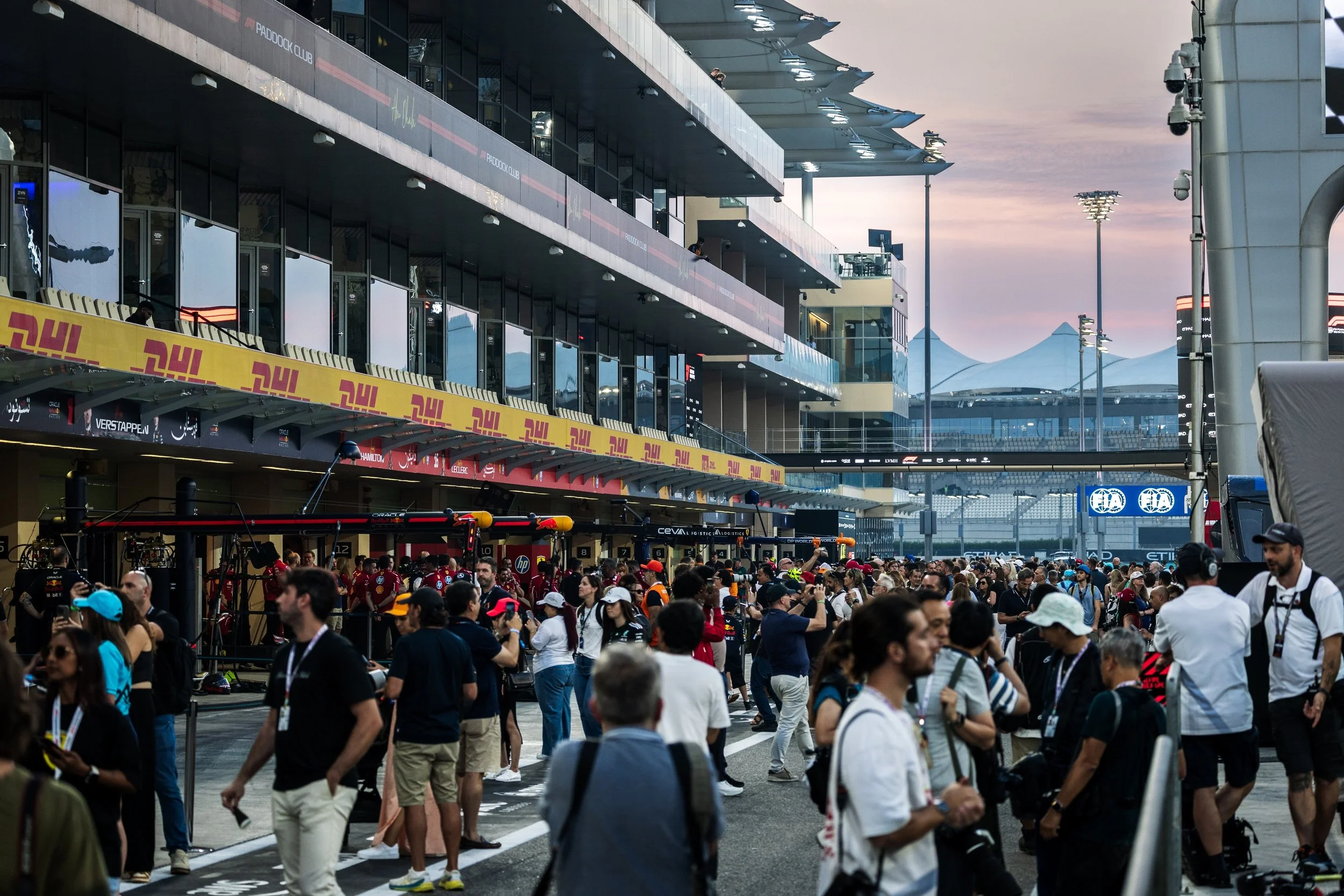
A Pit Lane Walk at the Formula 1 Abu Dhabi Grand Prix 2025. (Image credit: Jay Hirano - Shutterstock)
Here's a brutally honest statement: motorsports marketers have built a bubble around Formula 1, and despite their best intentions, this is contributing to the derailment of the sport’s immense potential.
On LinkedIn these days, everyone seems to be a motorsports expert, chiming in on the brilliance of Formula 1, its cultural relevance, its incomparable achievements, and its sure-bet ROI for brands chasing big wins with global audiences. Here's the problem, though, a lot of it is built on twisted truths and outright lies. Many marketers are caught up in the hype, trying to land the next pitch with a curious consumer brand, secure the next opportunity to charge a consulting or finder's fee, or gain favour with the powers that be at Formula 1, the teams, Liberty Media, and every other gatekeeper sitting on those highly-coveted Paddock passes.
Objectively, Formula 1 is brilliant and packed with potential that even some of the sport’s top-brass haven't yet fully grasped. The sport is however still finding its way to the cultural relevance it's truly capable of attaining. The sport’s achievements are modest, but it is not a sure bet for every single brand chasing a global audience. Additionally, Formula 1 isn't truly global until it successfully conquers Africa. If you have a look of shock, horror, confusion or are just generally puzzled by these assertions, then this journal entry is precisely for you.
Before we proceed, understand that this is not an attack, not on Formula 1, the teams or you, the eager observer or commentator. This is an invitation to everyone to reconsider how the reality and the future of this brilliant sport being built through both individual and collective efforts is seen.
Here is a comparison between Formula 1, the NBA, and the NFL:
The NFL was founded in 1920, the NBA in 1946, and Formula 1, though its rules were conceptualised earlier, began in earnest in 1950. All three leagues have had roughly the same amount of time to build their commercial and cultural footprint. While the structures of these leagues have developed differently over time, here is how things stand when you compare them right now:
The NFL generated approximately $23 billion in 2024–25, the NBA $12.25 billion, and Formula 1 $3.65 billion. The big catch here is that F1 is the only sporting league out of these three which operates as a near-global sport with activities across five continents.
The average NFL franchise is worth $7.65 billion and the average NBA franchise $5.51 billion. F1 teams are only recently crossing the $1 to $2 billion threshold, meaning even the most valuable F1 team currently wouldn't rank among the least valuable franchises in the two American leagues mentioned.
The NFL and NBA have secured media rights deals worth $110 billion and $76 billion respectively, each over 11 years. F1 has no comparable equivalent, with rights still fragmented across regional broadcasters.
Sponsorship is F1's most competitive metric, as it generated $2.04 billion against the NFL's $2.5 billion and the NBA's $1.7 billion in 2024.
The concept of cumulative social media follower numbers is laughable, but let us humour that lens for the purpose of this article. The NBA commands approximately 2.1 billion followers across platforms, the NFL operates at a comparable level. F1 currently sits around 97 million.
The numbers above aren't an indictment of Formula 1. They offer a moment of sobriety when we think about where the sport actually stands relative to the ambition of the conversation being had around it. This isn’t something to gloss over.
Right now, the most insignificant development in Formula 1 generates a wave of LinkedIn posts insisting it matters more than it appears. We’re talking about Formula 1 here, not a niche sport like curling or darts. If the talking points require that much convincing, surely something is off. Aren’t brands sophisticated enough to see past the noise, especially when the fuller commercial picture is laid out alongside the NFL and NBA? The contrast speaks for itself, so why is this happening?
Cultural relevance means nothing if it doesn't last beyond the next news cycle, and for Formula 1, true ubiquity remains out of reach despite its near-global footprint. Brands enter the sport without genuinely understanding the space, with IP restrictions and commercial realities only revealing themselves after contracts are signed and budgets committed. We're misleading some brands into believing Formula 1 is the answer when they'd be better served elsewhere, and they end up leaving after one partnership tenure filled with disappointment. We're also praising mediocre activations and partnerships loudly enough to convince brands that underwhelming performance is simply what Formula 1 delivers. The right brand fit is about more than just a direct relationship between a brand and a team. True success is only really achieved through a robust ecosystem where learning takes place, secondary partnerships can form, and every stakeholder is better positioned to realise real ROI. If this ecosystem isn't being built honestly, no amount of LinkedIn cheerleading will change the commercial outcome we ought to be chasing.
The most damaging consequence of all this noise is that it suffocates the honest, critical thinking the sport needs to help it better identify its weaknesses, close the gap on its real competitors, and build a commercial strategy worthy of what Formula 1 could genuinely become.
We need more open critique of partnership choices, activations, marketing strategies and even policies. It is helpful to have debates behind closed doors, but more so openly so that learning can be real and accessible. In this age of AI-written content and responses, it may be tough at first, but this is exactly how we separate the real from the fake and most importantly move this industry forward.
The work continues.
WINNING WITH WILLIAMS…
When we talk about alignment in Formula 1 partnerships, it's almost always brand alignment. Time alignment is far less talked about, despite being equally important.
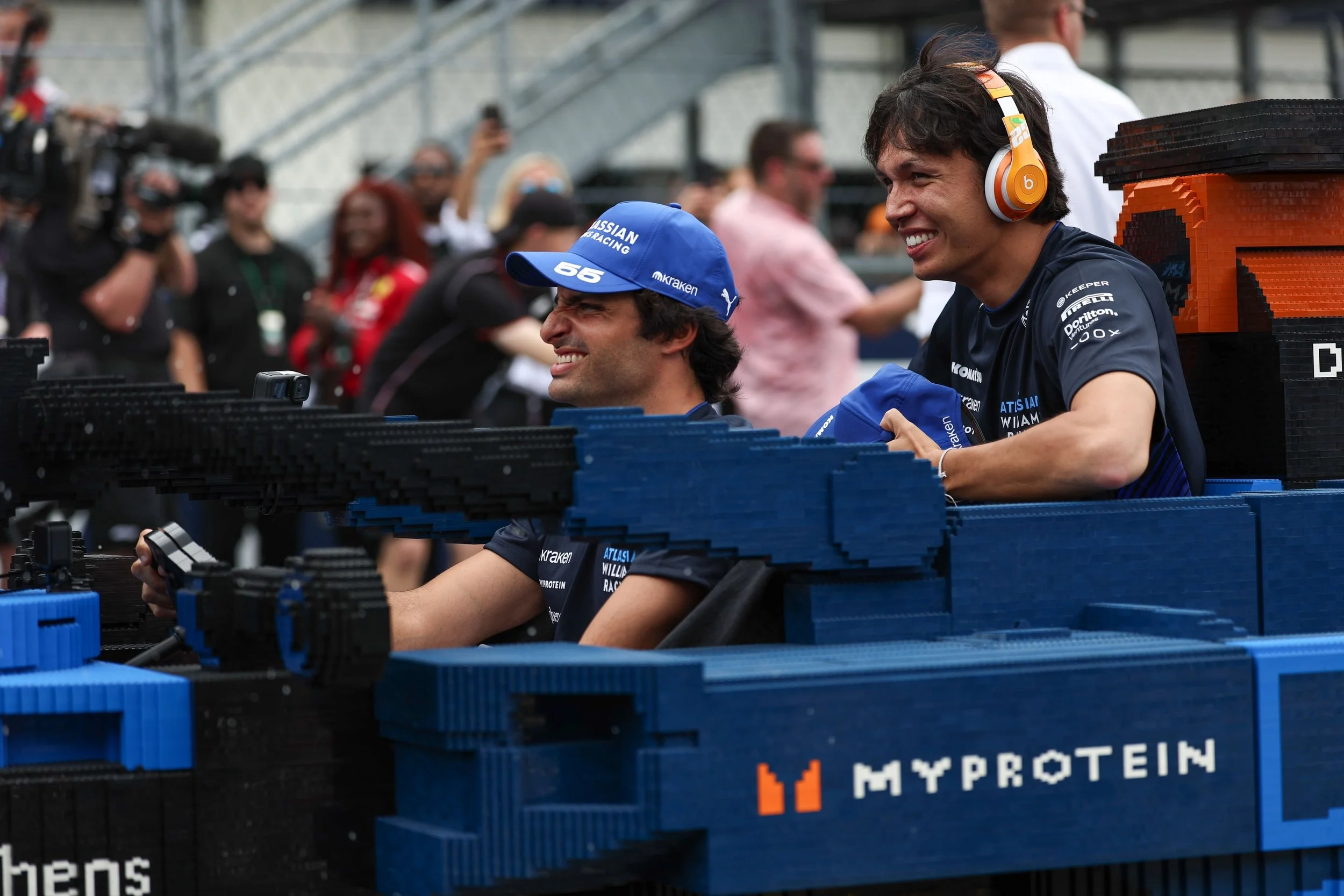
Atlassian William Racing F1 drivers Carlos Sainz and Alex Albon in a LEGO F1 car. (Image credit: Qian Jun - Shutterstock)
When we talk about alignment in Formula 1 partnerships, it's almost always brand alignment. Time alignment is far less talked about, despite being equally important. The problem is that some brands don't take the time to properly study the trajectory of the teams they are in discussions with, and on the flip side, some teams struggle to clearly articulate why right now is the right window for a partnership to truly deliver. Both failures leave value on the table. Myprotein and Built For Athletes are two brands that have quietly exited their Williams Racing sponsorships. That may have been the plan from the start based on defined tenure, budget constraints, specific objectives and so on. If that's the case, then, fair enough!
Here is the interesting thing about timing, though. In the case of Williams Racing, James Vowles has proven that he has a genuine plan for this team. Williams finished 5th in the 2025 Constructors' Championship. Fan engagement is also visibly moving, and I mean that literally. You're seeing Williams Racing merch on so many more fans at circuits these days, and it wasn’t like that even just a few seasons ago. I still don’t think they have the most stellar partner activations, but there has been a noticeable shift there in a positive direction. Any brand walking away from Williams Racing right now is leaving the cinema before the third act.
The 2026 season has started awkwardly for the team, but that applies to almost every team on the grid, barring Mercedes-AMG PETRONAS Formula One Team and perhaps Scuderia Ferrari. The season has plenty of runway. If the current trajectory is sustained, then the team is certainly at an inflection point, and the brands that are smart enough to join now or stay for the long haul will be the ones who got the timing right and enjoyed the biggest value add.
BEHIND THE DISCONTENT: The Transitional Fan
This is a fan category that Formula 1, and most sports chasing comparable growth, does not yet have a name for. The transitional fan.
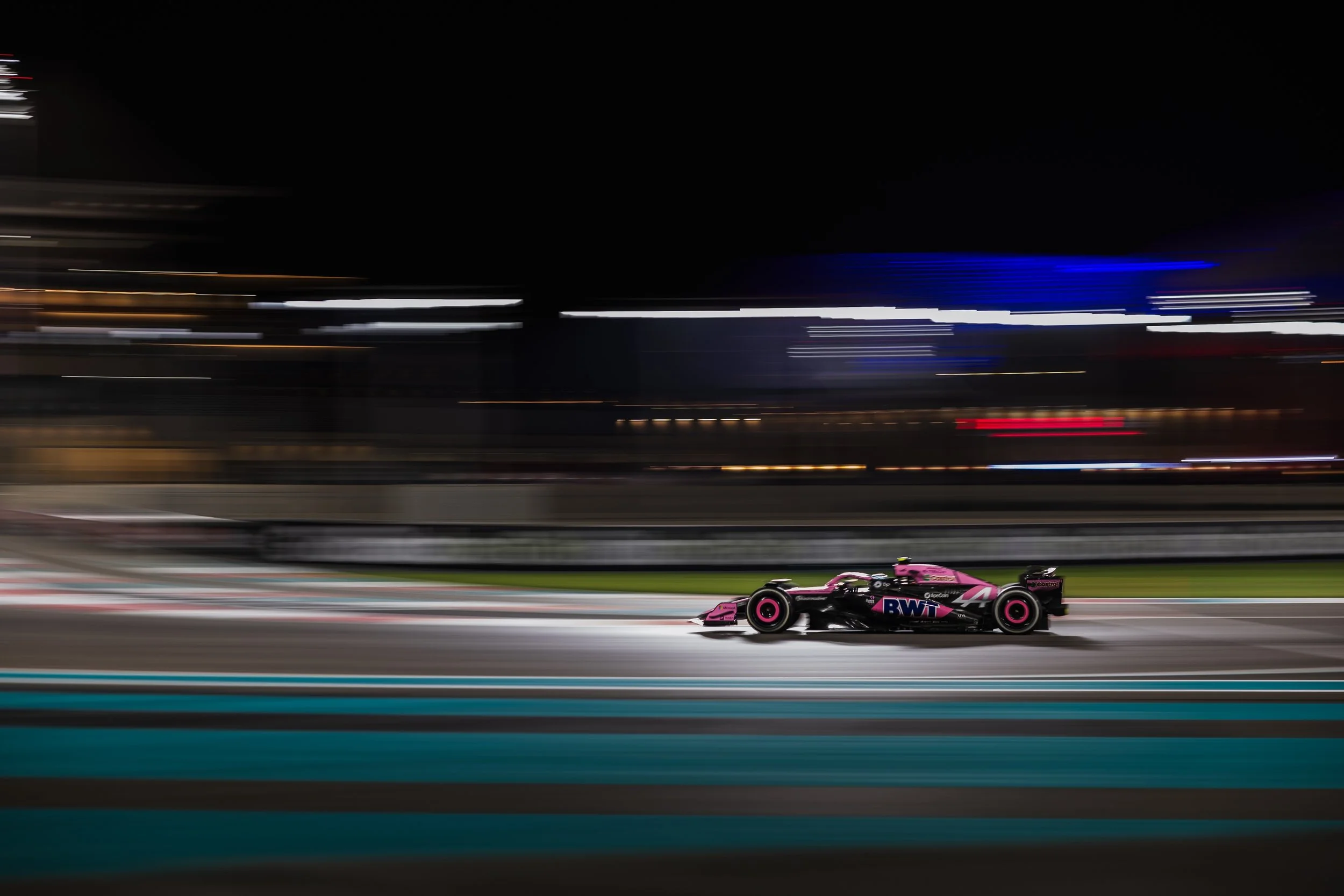
An Alpine F1 car whizzing past on the track. (Image credit: Jay Hirano - Shutterstock)
What is all this talk about Formula 1 losing its spark? Curiously, it seems to be gaining momentum at the same time.
The apparent dissatisfaction is worth examining, because the answer is not in the regulations, the celebrity guest list, or the number of influencers spotted in the paddock. It is found in a structural shift that Formula 1, its media partners, and its commercial partners have not yet fully understood or addressed.
For a long time, F1 had all the on-track excitement but not much else. Core racing fans were satisfied. Casual and prospective fans were not. Then the sport found a sweet spot under Liberty Media's ownership: on-track action paired with celebrity presence, drivers expressing their personalities on social media, lifestyle elements woven into the race weekend, and teams building compelling new identities. For a time, that combination kept both old and new audiences engaged. That balance has since shifted, hence the growing discourse declaring that F1 has lost the plot.
Interestingly, this chatter is coming from both long-time and relatively recent fans. Both groups are worth listening to.
It’s important to understand that F1 did not suddenly change course. The COVID lockdowns gave Drive to Survive a significant growth spike, and F1 responded immediately, serving an entirely new audience at a pace that tracked well with that growth curve. Five years on, many of those fans have graduated from being newcomers but have not yet settled into being deeply-entrenched followers. They are in transition. And that is where the story is.
Introducing the Transitional Fan
This is a fan category that Formula 1, and most sports chasing comparable growth, does not yet have a name for. The transitional fan.
F1 has historically managed two distinct audiences well: the long-time faithful, who need no onboarding, and the brand-new entrant, who simply needs an entry point, typically drawn in by hype, recommendation or general interest. The transitional fan sits between these two groups, moving deliberately from the new-entrant phase toward deep, entrenched fandom. They are not casual, but they are not yet core. They are in the most active and consequential phase of the fan journey, and they are currently the fastest-growing segment of F1's audience, arguably now larger in number than the long-time core fan base across many territories.
This fan does not need an introduction to the sport. They need depth made accessible. They need the sport to meet them at the point where curiosity tips into genuine investment. They understand the terminology beyond a basic level but desire knowledge of the sport's deeper complexities. They might not be able to construct a full tyre strategy before a race, but they understand the difference between compounds and can quickly grasp the reasoning behind a strategic call as a race develops. They appreciate the race itself just as much as they appreciate seeing Idris Elba, Tom Brady or Bella Hadid on the pre-race Grid Walk. Rather than gatekeep, they are keen to demonstrate their growing knowledge and would eagerly encourage newer fans into the sport or further up the fandom ladder.
The infrastructure that properly caters to this fan does not yet exist in Formula 1. As a result, there is growing discontent coming directly from this group. They are not disenchanted with the sport. They are outgrowing the version of it that was built to attract them and cannot yet find anything designed to serve where they currently are.
This discontent is legible in the data. It shows up as declining viewership for specific races, app downloads without strong repeat usage, disgruntled commentary online, and a general detachment from race attendance and merchandise purchases. It also shows up as increased social media views without commensurate engagement in likes and shares, which is a reliable signal that an audience is looking for satisfaction and not finding it.
What This Means for the Sport and Its Partners
The regulations conversation sits within this same frame. At no point in Formula 1's history has its entire audience been simultaneously satisfied. It is a statistical impossibility. In under a decade, the central complaint has shifted from Mercedes’ sustained dominance to Red Bull's, to whispers about McLaren's internal team politics. The on-track narrative is always in motion.
Long-time core fans bring the most sophisticated reading of what the current regulations are attempting to achieve. Formula 1 has pursued changes that signal greater opportunity for overtaking and on-track excitement, both to re-engage transitional fans and to hold the attention of newer ones, but not with the intention to alienate to the long-time faithful fans. Whether this regulatory cycle has delivered on that promise is a question the current season will answer, and it is clearly being addressed. What is certain, though, is that regulations are cyclical. The balance disrupted in pursuit of advancement will correct itself. It always does.
What matters more, particularly for brands and commercial partners seeking to build meaningful positions within this sport, is that Formula 1 is building something long-term. New fans will have entry points. Transitional fans will eventually have the content, experiences and platforms they need to grow within the sport. Long-time fans who step back temporarily will always find a way back in. F1 is simultaneously extending its cultural reach in ways designed to make the sport a permanent fixture in daily life, not a trend to be cycled through.
The transitional fan is the most commercially significant audience segment that Formula 1's partner ecosystem is not yet directly addressing. Understanding this group, their behaviour, their appetite, and their trajectory, is not just a content strategy question. It is a commercial one.