ONE FASHION-FORWARD FORMULA
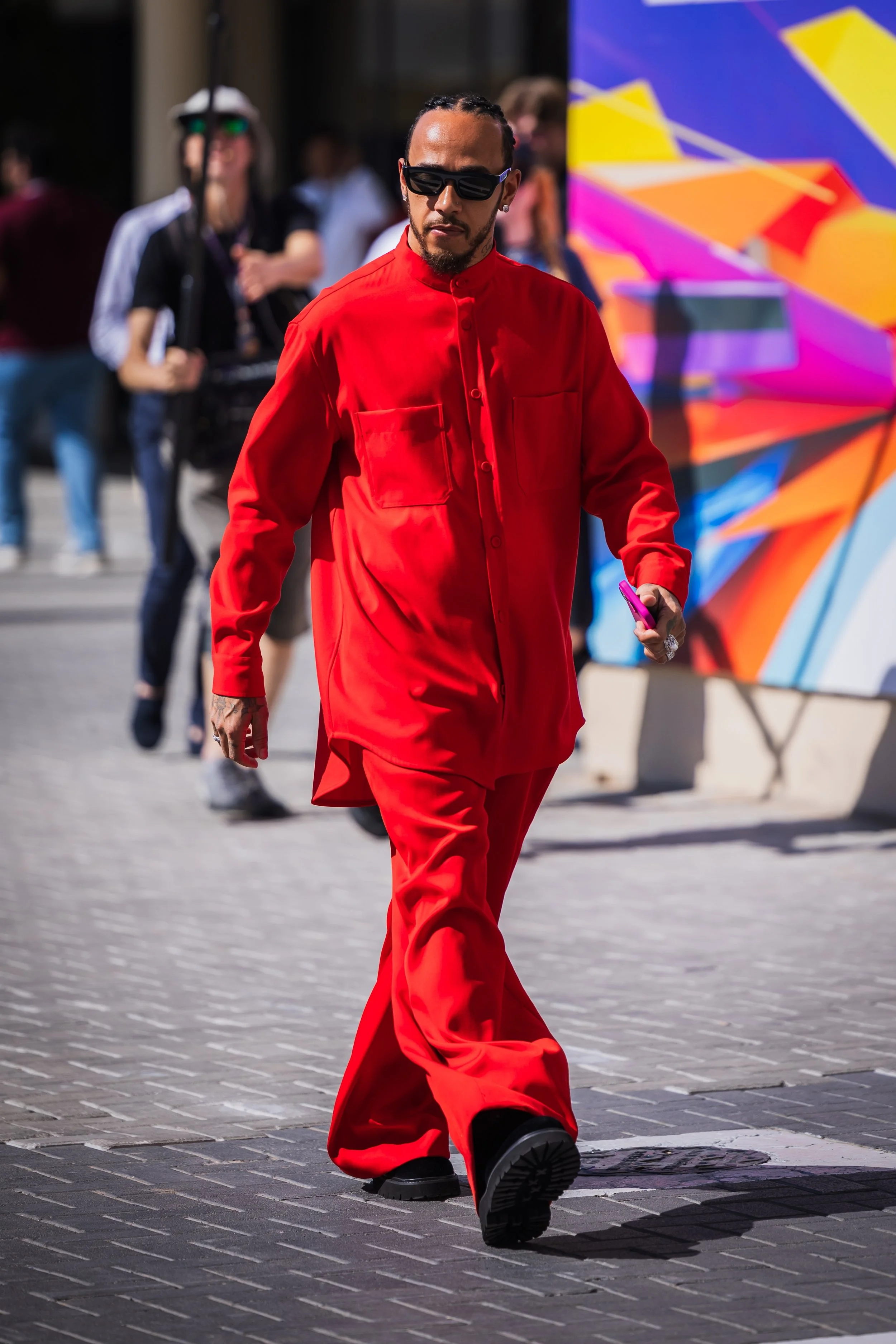
Sir Lewis Hamilton wearing Rick Owens in the Formula 1 Paddock. (Image credit: Jay Hirano - Shutterstock)
There has been considerable talk about fashion having found its moment in Formula 1. The reality is more nuanced than the narrative suggests. What Formula 1 has had is a merchandise moment through apparel, and it is not new; it has simply evolved. Fashion and apparel are not the same thing, and the distinction matters enormously for anyone seeking to build a meaningful position at the intersection of the sport and the fashion industry.
Apparel Is Not Fashion
To assess whether fashion has truly arrived in Formula 1, it is necessary to first separate fashion from apparel. Apparel serves a functional and practical purpose. This includes team kits, fan merchandise, and performance-driven race gear, and while these help build community among fans, they typically do not dictate trends or influence culture beyond the sport itself. Fashion is something different entirely. It is about cultural expression, identity, and storytelling. It is not simply about what is worn, but why, how, and with what significance. That distinction is where the current discourse around Formula 1 and fashion needs much better understanding.
What Formula 1 has achieved over the last several years is a genuine expansion of its addressable apparel market. Fan demographics have shifted, lifestyle appeal has broadened, and premium sportswear partnerships have followed the audience. There is a commercial significance here that should not be dismissed. However, commercial significance is not cultural integration, and the two are being conflated at an expanding rate.
The Partnerships on the Table
Collaborations such as Reiss x McLaren or BOSS x Aston Martin Aramco are real partnerships producing real product. They are also, by any honest structural assessment, brand licensing exercises with elevated positioning. They reflect the sport's growing desirability as a co-branding vehicle. Reiss has released strong collections under its McLaren partnership, and HUGO x Visa Cash App RB has delivered standout pieces. M&S x Williams Racing is the most recent addition to this list, and it will be worth watching closely. These partnerships reflect Formula 1's desirability. They do not yet reflect the fashion industry having renegotiated its relationship with motorsport in any meaningful or lasting way. No creative director has restructured a house around Formula 1. No major fashion week moment has been genuinely shaped by the sport's internal culture rather than its borrowed aesthetics. Formula 1's language has not found expression in fashion, even as fashion's language attempts to find it in Formula 1. That speaks to a sort of one-sidedness, buttressing the point that this is not an organic relationship being developed.
The Logo Problem
The moment a fashion piece requires a team logo to justify its existence within the sport, it has crossed from fashion into branded merchandise with elevated production values. The logo is doing the cultural work that the design should be doing on its own. One can lean into the nuance that co-branding is not automatically disqualifying in fashion. Supreme x Louis Vuitton, for instance, required both logos and still constituted a genuine fashion moment because the creative dialogue between the two entities was real and the resulting pieces had a life beyond the collaboration itself. The test is whether the item would retain its identity and desirability without the partner's name attached.
The key difference when citing the Supreme example is that the brand operates as a creative entity with its own design identity, cultural authority, and independent release cadence. The Louis Vuitton collaboration worked because two fashion-adjacent entities with distinct creative languages met in the middle. Neither needed the other's logo to exist. The meeting of the two iconic logos was the entire point.
That is categorically different from a sports team, whose primary identity is athletic competition. When McLaren collaborates with Reiss, McLaren is not bringing a design language to the table. It is bringing an audience, a colour palette, and a logo. Reiss is doing the fashion work. The team is providing the distribution vehicle. That dynamic is closer to a licensing arrangement than a creative collaboration.
The Benchmark
The benchmark for what genuine integration between sport and fashion looks like at its ceiling is Jordan Brand. Nike created an entirely separate entity with its own visual identity, silhouette language, and cultural footprint that eventually outgrew its association with basketball entirely. The Jumpman is recognised globally, even by people who have never watched a single basketball game. Formula 1 has nothing remotely equivalent, and the distance between where it currently stands and that benchmark is the most honest measure of how far the fashion moment the sport is seeking still has to travel.
The Ferrari Exception
Ferrari occupies a category of its own here and deserves to be considered separately. The Ferrari style offering is genuinely distinctive, with a heritage and aesthetic authority that most teams cannot credibly claim. The house has built a credible fashion brand that checks all the boxes. It is spotted on A-list celebrities on red carpets and was included in Beyoncé's last tour wardrobe. But even Ferrari's fashion presence has not been properly integrated into the Formula 1 ecosystem in any way that advances the sport's broader cultural relationship with the industry. One can highlight the occasional pieces Lewis Hamilton can be spotted wearing in the paddock, and not much else. Ferrari Style exists almost entirely adjacent to the sport rather than within it, which is a telling illustration of the structural problem at hand.
The Gucci Question
If the rumoured Gucci title partnership with the Alpine F1 team materialises, it will represent the most significant fashion adjacency the sport has seen at that level in recent times. The question is not whether Gucci's name on an Alpine car would generate attention. It would. The question is whether there is a framework in place to convert that attention into something with genuine cultural weight. Based on what currently exists within Formula 1's content and experiential architecture, the answer is not yet. This matters particularly for Gucci, a house whose challenges are well documented and whose path back to relevance is widely understood to run through product, not profile. Visibility alone will not solve a product problem, and an entry into Formula 1 without a meaningful restructuring of both its core offering and its motorsport-specific proposition would risk being an exercise in bad business at the precise moment the intersection of fashion and motorsport demands something better.
One must recall the years of Benetton in Formula 1. A fashion brand had ownership of a team, not just a causal collaboration or title partnership, and even that did not yield any meaningful integration of fashion and motorsport with generational reach or influence.
The Driver Problem
The driver side of the equation presents its own challenges. There have been increased efforts to place drivers at fashion shows and to curate paddock arrival outfits, but much of this has fallen flat in the absence of a coherent strategy. The twenty-two drivers command over ninety percent of the sport's off-track screen time, and among them, only one, Sir Lewis Hamilton, can credibly be considered a style figure with a genuine and sustained connection to fashion. The Chivas Regal campaign featuring Charles Leclerc illustrated what happens when there is no clear stylistic alignment between a driver and a brand. Many drivers remain locked into team-level deals with brands that do not reflect their individual aesthetics, which produces results that satisfy nobody and advance nothing.
Tommy Hilfiger has had a long-standing presence in the sport, having most recently ended its partnership with Mercedes-AMG Petronas and moved to start a new relationship with the Cadillac F1 team, while extending its reach to the all-female F1 Academy. Despite this sustained commitment, the brand's presence in Formula 1 remains easily forgotten whenever it is not directly in front of a camera. Admittedly, that is a strategy problem as much as it is a platform problem.
Attention Is Not Architecture
What Formula 1 marketing discourse is currently overstating is the depth of the integration that does exist. Desirability is not the same as influence, just as adjacency is not the same as authorship. The sport is teasing fashion's attention, but attention is not architecture, and the sport is not yet building the space for that architecture to take form.
The structural gaps are significant, and one of the most revealing is the absence of a recognisable Formula 1 silhouette. Every major sport has one. A baseball cap is instantly recognisable. A hockey jersey reads differently from a basketball jersey without a single logo in sight. The silhouettes themselves carry the cultural identity of the sport. Formula 1 does not yet have an equivalent. Strip away the team logos and brand affiliations, and there is very little that is immediately legible as belonging to this sport's visual language. This is a fashion problem, and it is one that no number of co-branded capsule collections will resolve on its own.
The space has not been intentionally created for fashion to breathe in Formula 1. Not in the sport's content strategy, not in the race weekend experience. There is no dedicated editorial platform for fashion within Formula 1's ecosystem, no paddock style coverage built for digital audiences, no influencer strategy designed to drive meaningful engagement for fashion partners, and no creative framework connecting fashion brands to the sport's growing cultural footprint. Formula 1 must build the platform for fashion to integrate into, rather than expecting fashion to find its footing within a structure never designed to accommodate it.
It is also worth questioning what fashion brands themselves are doing to maximise their presence in the sport. Brands with clear Formula 1 synergy, from Christian Louboutin, Comme des Garçons and Amiri at the higher end, to H&M, ASOS and River Island at the accessible end, have yet to place any serious bet on the sport. The opportunity is visible, but the activation is lagging.
The Foundation Still Needs Building
The sport and the industry are both waiting to see who carries the torch. But torches do not carry themselves, and the runway, so to speak, has not been built. For the relationship to become what the press releases are already claiming it to be, fashion houses must engage with the sport's ecosystem beyond product drops, designers need genuine proximity to the paddock rather than campaign shoots, and collaborations must be built around shared creative language rather than shared audiences alone.
Formula 1 is closer to a genuine fashion moment than it has ever been. It is just not there yet. And until the sport and its partners are willing to build the infrastructure that makes deep integration possible, the fashion moment will remain a compelling story in search of a foundation.